Spectroscopic Selection Degrader to Emulate zCOSMOS Training Samples
last run successfully: Feb 9, 2026
The spectroscopic_selection degrader can be used to model the spectroscopic success rates in training sets based on real data. Given a 2-dimensional grid of spec-z success ratio as a function of two variables (often magnitude, color, or redshift), the degrader will draw the appropriate fraction of samples from the input data and return a sample with incompleteness modeled.
The degrader takes the following arguments:
N_tot: number of selected sourcesnondetect_val: non detected magnitude value to be excluded (usually 99.0, -99.0 or NaN).downsample: If true, downsample the selected sources into a total number of N_tot.success_rate_dir: The path to the directory containing success rate files.colnames: a dictionary that includes necessary columns (magnitudes, colors and redshift) for selection. For magnitudes, the keys are ugrizy; for colors, the keys are, for example, gr standing for g-r; for redshift, the key is ‘redshift’. In this demo, zCOSMOS takes {‘i’:‘i’, ‘redshift’:‘redshift’} as minimum necessary input
In this quick notebook we’ll select galaxies based on zCOSMOS selection function.
Note: If you’re interested in running this in pipeline mode, see
11_Spectroscopic_Selection_for_zCOSMOS.ipynb
in the pipeline_examples/creation_examples/ folder.
import matplotlib.pyplot as plt
import numpy as np
import pandas as pd
from rail.utils.path_utils import find_rail_file

from rail import interactive as ri
Install FSPS with the following commands:
pip uninstall fsps
git clone --recursive https://github.com/dfm/python-fsps.git
cd python-fsps
python -m pip install .
export SPS_HOME=$(pwd)/src/fsps/libfsps

LEPHAREDIR is being set to the default cache directory:
/home/runner/.cache/lephare/data
More than 1Gb may be written there.
LEPHAREWORK is being set to the default cache directory:
/home/runner/.cache/lephare/work
Default work cache is already linked.
This is linked to the run directory:
/home/runner/.cache/lephare/runs/20260601T134643
A module that was compiled using NumPy 1.x cannot be run in
NumPy 2.2.6 as it may crash. To support both 1.x and 2.x
versions of NumPy, modules must be compiled with NumPy 2.0.
Some module may need to rebuild instead e.g. with 'pybind11>=2.12'.

If you are a user of the module, the easiest solution will be to
downgrade to 'numpy<2' or try to upgrade the affected module.
We expect that some modules will need time to support NumPy 2.

Traceback (most recent call last):  File "/opt/hostedtoolcache/Python/3.10.20/x64/lib/python3.10/runpy.py", line 196, in _run_module_as_main
    return _run_code(code, main_globals, None,
  File "/opt/hostedtoolcache/Python/3.10.20/x64/lib/python3.10/runpy.py", line 86, in _run_code
    exec(code, run_globals)
  File "/opt/hostedtoolcache/Python/3.10.20/x64/lib/python3.10/site-packages/ipykernel_launcher.py", line 18, in <module>
    app.launch_new_instance()
  File "/opt/hostedtoolcache/Python/3.10.20/x64/lib/python3.10/site-packages/traitlets/config/application.py", line 1082, in launch_instance
    app.start()
  File "/opt/hostedtoolcache/Python/3.10.20/x64/lib/python3.10/site-packages/ipykernel/kernelapp.py", line 758, in start
    self.io_loop.start()
  File "/opt/hostedtoolcache/Python/3.10.20/x64/lib/python3.10/site-packages/tornado/platform/asyncio.py", line 211, in start
    self.asyncio_loop.run_forever()
  File "/opt/hostedtoolcache/Python/3.10.20/x64/lib/python3.10/asyncio/base_events.py", line 603, in run_forever
    self._run_once()
  File "/opt/hostedtoolcache/Python/3.10.20/x64/lib/python3.10/asyncio/base_events.py", line 1909, in _run_once
    handle._run()
  File "/opt/hostedtoolcache/Python/3.10.20/x64/lib/python3.10/asyncio/events.py", line 80, in _run
    self._context.run(self._callback, *self._args)
  File "/opt/hostedtoolcache/Python/3.10.20/x64/lib/python3.10/site-packages/ipykernel/utils.py", line 71, in preserve_context
    return await f(*args, **kwargs)
  File "/opt/hostedtoolcache/Python/3.10.20/x64/lib/python3.10/site-packages/ipykernel/kernelbase.py", line 621, in shell_main
    await self.dispatch_shell(msg, subshell_id=subshell_id)
  File "/opt/hostedtoolcache/Python/3.10.20/x64/lib/python3.10/site-packages/ipykernel/kernelbase.py", line 478, in dispatch_shell
    await result
  File "/opt/hostedtoolcache/Python/3.10.20/x64/lib/python3.10/site-packages/ipykernel/ipkernel.py", line 372, in execute_request
    await super().execute_request(stream, ident, parent)
  File "/opt/hostedtoolcache/Python/3.10.20/x64/lib/python3.10/site-packages/ipykernel/kernelbase.py", line 834, in execute_request
    reply_content = await reply_content
  File "/opt/hostedtoolcache/Python/3.10.20/x64/lib/python3.10/site-packages/ipykernel/ipkernel.py", line 464, in do_execute
    res = shell.run_cell(
  File "/opt/hostedtoolcache/Python/3.10.20/x64/lib/python3.10/site-packages/ipykernel/zmqshell.py", line 663, in run_cell
    return super().run_cell(*args, **kwargs)
  File "/opt/hostedtoolcache/Python/3.10.20/x64/lib/python3.10/site-packages/IPython/core/interactiveshell.py", line 3077, in run_cell
    result = self._run_cell(
  File "/opt/hostedtoolcache/Python/3.10.20/x64/lib/python3.10/site-packages/IPython/core/interactiveshell.py", line 3132, in _run_cell
    result = runner(coro)
  File "/opt/hostedtoolcache/Python/3.10.20/x64/lib/python3.10/site-packages/IPython/core/async_helpers.py", line 128, in _pseudo_sync_runner
    coro.send(None)
  File "/opt/hostedtoolcache/Python/3.10.20/x64/lib/python3.10/site-packages/IPython/core/interactiveshell.py", line 3336, in run_cell_async
    has_raised = await self.run_ast_nodes(code_ast.body, cell_name,
  File "/opt/hostedtoolcache/Python/3.10.20/x64/lib/python3.10/site-packages/IPython/core/interactiveshell.py", line 3519, in run_ast_nodes
    if await self.run_code(code, result, async_=asy):
  File "/opt/hostedtoolcache/Python/3.10.20/x64/lib/python3.10/site-packages/IPython/core/interactiveshell.py", line 3579, in run_code
    exec(code_obj, self.user_global_ns, self.user_ns)
  File "/tmp/ipykernel_5232/1741399557.py", line 6, in <module>
    from rail import interactive as ri
  File "/opt/hostedtoolcache/Python/3.10.20/x64/lib/python3.10/site-packages/rail/interactive/__init__.py", line 3, in <module>
    from . import calib, creation, estimation, evaluation, tools
  File "/opt/hostedtoolcache/Python/3.10.20/x64/lib/python3.10/site-packages/rail/interactive/calib/__init__.py", line 3, in <module>
    from rail.utils.interactive.initialize_utils import _initialize_interactive_module
  File "/opt/hostedtoolcache/Python/3.10.20/x64/lib/python3.10/site-packages/rail/utils/interactive/initialize_utils.py", line 17, in <module>
    from rail.utils.interactive.base_utils import (
  File "/opt/hostedtoolcache/Python/3.10.20/x64/lib/python3.10/site-packages/rail/utils/interactive/base_utils.py", line 10, in <module>
    rail.stages.import_and_attach_all(silent=True)
  File "/opt/hostedtoolcache/Python/3.10.20/x64/lib/python3.10/site-packages/rail/stages/__init__.py", line 74, in import_and_attach_all
    RailEnv.import_all_packages(silent=silent)
  File "/opt/hostedtoolcache/Python/3.10.20/x64/lib/python3.10/site-packages/rail/core/introspection.py", line 541, in import_all_packages
    _imported_module = importlib.import_module(pkg)
  File "/opt/hostedtoolcache/Python/3.10.20/x64/lib/python3.10/importlib/__init__.py", line 126, in import_module
    return _bootstrap._gcd_import(name[level:], package, level)
  File "/opt/hostedtoolcache/Python/3.10.20/x64/lib/python3.10/site-packages/rail/som/__init__.py", line 1, in <module>
    from rail.creation.degraders.specz_som import *
  File "/opt/hostedtoolcache/Python/3.10.20/x64/lib/python3.10/site-packages/rail/creation/degraders/specz_som.py", line 15, in <module>
    from somoclu import Somoclu
  File "/opt/hostedtoolcache/Python/3.10.20/x64/lib/python3.10/site-packages/somoclu/__init__.py", line 11, in <module>
    from .train import Somoclu
  File "/opt/hostedtoolcache/Python/3.10.20/x64/lib/python3.10/site-packages/somoclu/train.py", line 25, in <module>
    from .somoclu_wrap import train as wrap_train
  File "/opt/hostedtoolcache/Python/3.10.20/x64/lib/python3.10/site-packages/somoclu/somoclu_wrap.py", line 11, in <module>
    import _somoclu_wrap
---------------------------------------------------------------------------

ImportError                               Traceback (most recent call last)

File /opt/hostedtoolcache/Python/3.10.20/x64/lib/python3.10/site-packages/numpy/core/_multiarray_umath.py:44, in __getattr__(attr_name)
     39     # Also print the message (with traceback).  This is because old versions
     40     # of NumPy unfortunately set up the import to replace (and hide) the
     41     # error.  The traceback shouldn't be needed, but e.g. pytest plugins
     42     # seem to swallow it and we should be failing anyway...
     43     sys.stderr.write(msg + tb_msg)
---> 44     raise ImportError(msg)
     46 ret = getattr(_multiarray_umath, attr_name, None)
     47 if ret is None:


ImportError:
A module that was compiled using NumPy 1.x cannot be run in
NumPy 2.2.6 as it may crash. To support both 1.x and 2.x
versions of NumPy, modules must be compiled with NumPy 2.0.
Some module may need to rebuild instead e.g. with 'pybind11>=2.12'.

If you are a user of the module, the easiest solution will be to
downgrade to 'numpy<2' or try to upgrade the affected module.
We expect that some modules will need time to support NumPy 2.
Warning: the binary library cannot be imported. You cannot train maps, but you can load and analyze ones that you have already saved.
The problem occurs because either compilation failed when you installed Somoclu or a path is missing from the dependencies when you are trying to import it. Please refer to the documentation to see your options.
Let’s make fake data for zCOSMOS selection.
i = np.random.uniform(low=18, high=25.9675, size=(2000000,))
gz = np.random.uniform(low=-1.98, high=5.98, size=(2000000,))
u = np.full_like(i, 20.0, dtype=np.double)
g = np.full_like(i, 20.0, dtype=np.double)
r = np.full_like(i, 20.0, dtype=np.double)
y = np.full_like(i, 20.0, dtype=np.double)
z = g - gz
redshift = np.random.uniform(size=len(i)) * 2
Standardize the column names:
mockdict = {}
for label, item in zip(
    ["u", "g", "r", "i", "z", "y", "redshift"], [u, g, r, i, z, y, redshift]
):
    mockdict[f"{label}"] = item
np.repeat(item, 100).flatten()
df = pd.DataFrame(mockdict)
df.head()
| u | g | r | i | z | y | redshift | |
|---|---|---|---|---|---|---|---|
| 0 | 20.0 | 20.0 | 20.0 | 25.692555 | 17.028915 | 20.0 | 1.493043 |
| 1 | 20.0 | 20.0 | 20.0 | 23.719575 | 19.812460 | 20.0 | 0.401460 |
| 2 | 20.0 | 20.0 | 20.0 | 22.046114 | 15.558401 | 20.0 | 1.255974 |
| 3 | 20.0 | 20.0 | 20.0 | 25.106273 | 17.784584 | 20.0 | 1.852565 |
| 4 | 20.0 | 20.0 | 20.0 | 20.571933 | 19.199345 | 20.0 | 1.303478 |
Now, let’s import the spectroscopic_selections degrader for zCOSMOS.
The ratio file for zCOSMOS is located in the
RAIL/src/rail/examples/creation/data/success_rate_data/ directory,
as we are in RAIL/examples/creation folder named
zCOSMOS_success.txt; the binning in i band and redshift are given in
zCOSMOS_I_sampling.txt and zCOSMOS_z_sampling.txt.
We will set a random seed for reproducibility, and set the output file to write our incomplete catalog to “test_hsc.pq”.
Let’s run the code and see how long it takes:
%%time
trim_data = ri.creation.degraders.spectroscopic_selections.spec_selection_zCOSMOS(
    sample=df, downsample=False, colnames={"i": "i", "redshift": "redshift"}
)
Inserting handle into data store. input: None, SpecSelection_zCOSMOS
Inserting handle into data store.  output: inprogress_output.pq, SpecSelection_zCOSMOS
CPU times: user 1.29 s, sys: 14.3 ms, total: 1.31 s
Wall time: 1.3 s
trim_data["output"].info()
<class 'pandas.core.frame.DataFrame'>
Index: 502900 entries, 6 to 1999998
Data columns (total 7 columns):
 #   Column    Non-Null Count   Dtype
---  ------    --------------   -----
 0   u         502900 non-null  float64
 1   g         502900 non-null  float64
 2   r         502900 non-null  float64
 3   i         502900 non-null  float64
 4   z         502900 non-null  float64
 5   y         502900 non-null  float64
 6   redshift  502900 non-null  float64
dtypes: float64(7)
memory usage: 30.7 MB
And we see that we’ve kept 503967 out of the 2,000,000 galaxies in the initial sample, so about 25% of the initial sample. To visualize our cuts, let’s read in the success ratios file and plot our sample overlaid with an alpha of 0.05, that way the strength of the black dot will give a visual indication of how many galaxies in each cell we’ve kept.
# compare to sum of ratios * 100
ratio_file = find_rail_file(
    "examples_data/creation_data/data/success_rate_data/zCOSMOS_success.txt"
)
ratios = np.loadtxt(ratio_file)
ibin_ = np.arange(18, 22.4, 0.01464226, dtype=np.float64)
zbin_ = np.arange(0, 1.4, 0.00587002, dtype=np.float64)

ibin, zbin = np.meshgrid(ibin_, zbin_)
plt.figure(figsize=(12, 12))
plt.title("zCOSMOS", fontsize=20)

c = plt.pcolormesh(zbin, ibin, ratios.T, cmap="turbo", vmin=0, vmax=1, alpha=0.8)
plt.scatter(
    trim_data["output"]["redshift"], trim_data["output"]["i"], s=2, c="k", alpha=0.05
)
plt.xlabel("redshift", fontsize=15)
plt.ylabel("i band Magnitude", fontsize=18)
cb = plt.colorbar(c, label="success rate", orientation="horizontal", pad=0.1)
cb.set_label(label="success rate", size=15)
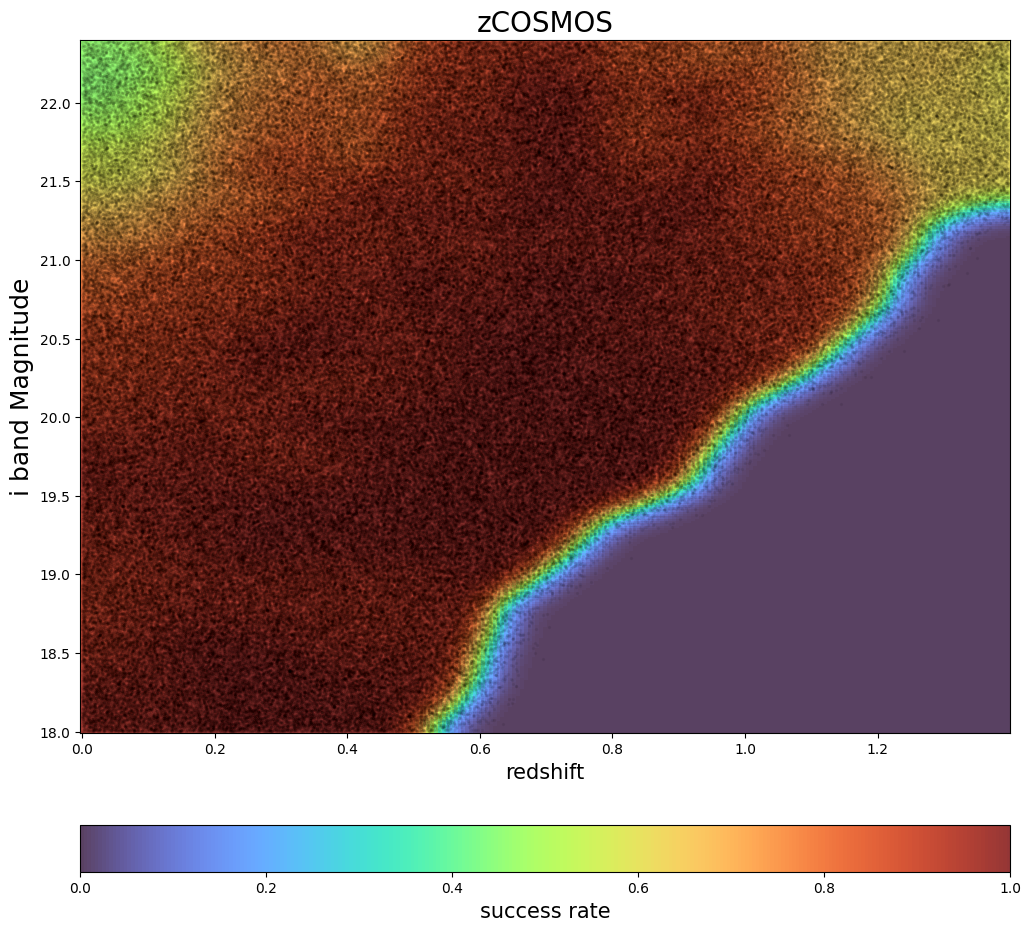
The colormap shows the zCOSMOS success ratios and the strenth of the black dots shows how many galaxies were actually kept. We see perfect agreement between our predicted ratios and the actual number of galaxies kept, the degrader is functioning properly, and we see a nice visual representation of the resulting spectroscopic sample incompleteness.