Evaluation
Evaluation is a type of RAIL stage which compares estimated photometric redshifts to known true values, in order to assess the performance of the estimation algorithm.
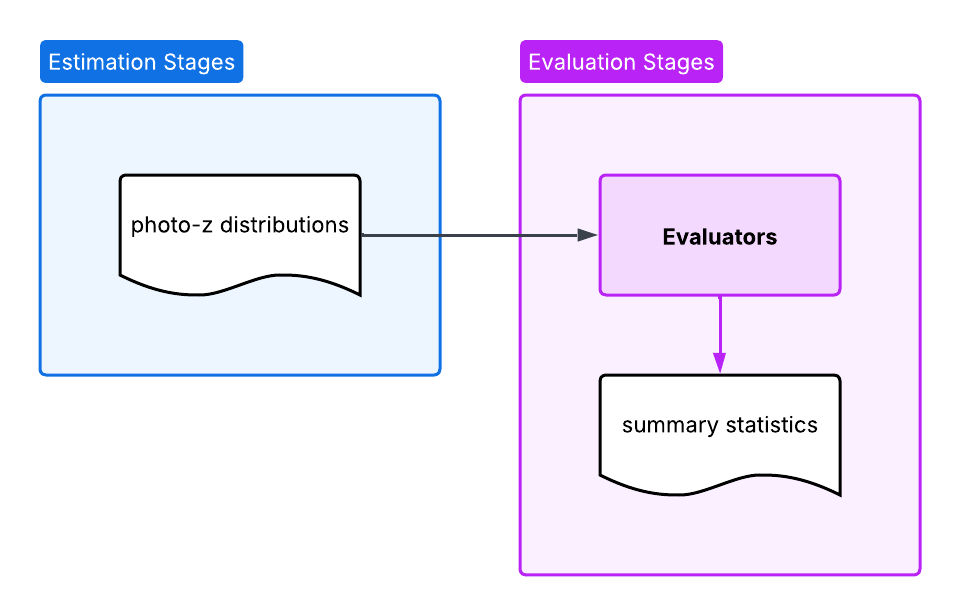
Evaluators
Evaluators evaluate the performance of a photo-z estimator against reference point estimate.
Distribution to Distribution
RAIL Package: https://github.com/LSSTDESC/rail_base
Evaluate the performance of a photo-z estimator against reference PDFs.
- class rail.evaluation.dist_to_dist_evaluator.DistToDistEvaluator
Evaluate the performance of a photo-z estimator against reference PDFs
- Parameters:
output_mode ([str] default=default) – What to do with the outputs. The options are ‘default’, where outputs will be written to files and some returned, and ‘return’, where outputs will only be returned and not written.
metrics ([list] default=[]) – The metrics you want to evaluate.
exclude_metrics ([list] default=[]) – List of metrics to exclude
metric_config ([dict] default={}) – configuration of individual_metrics
chunk_size ([int] default=10000) – Number of objects per chunk for parallel processing or to evalute per loop in single node processing
seed ([float] default=None) – Random seed value to use for reproducible results.
force_exact ([bool] default=False) – Force the exact calculation. This will not allow parallelization
metric_integration_limits ([list] default=[0.0, 3.0]) – The default end points for calculating metrics on a grid.
dx ([float] default=0.01) – The default step size when calculating metrics on a grid.
n_samples ([int] default=100) – The number of random samples to select for certain metrics.
input (QPHandle (INPUT))
truth (QPHandle (INPUT))
output (Hdf5Handle (OUTPUT))
summary (Hdf5Handle (OUTPUT))
single_distribution_summary (QPDictHandle (OUTPUT))
- __init__(args, **kwargs)
Constructor: Do RailStage specific initialization
- Parameters:
args (Any)
kwargs (Any)
- Return type:
None
- classmethod __new__(*args, **kwargs)
Distribution to Point
RAIL Package: https://github.com/LSSTDESC/rail_base
Evaluate the performance of a photo-z estimator against reference point estimate.
- class rail.evaluation.dist_to_point_evaluator.DistToPointEvaluator
Evaluate the performance of a photo-z estimator against reference point estimate
- Parameters:
output_mode ([str] default=default) – What to do with the outputs. The options are ‘default’, where outputs will be written to files and some returned, and ‘return’, where outputs will only be returned and not written.
metrics ([list] default=[]) – The metrics you want to evaluate.
exclude_metrics ([list] default=[]) – List of metrics to exclude
metric_config ([dict] default={}) – configuration of individual_metrics
chunk_size ([int] default=10000) – Number of objects per chunk for parallel processing or to evalute per loop in single node processing
seed ([float] default=None) – Random seed value to use for reproducible results.
force_exact ([bool] default=False) – Force the exact calculation. This will not allow parallelization
metric_integration_limits ([list] default=[0.0, 3.0]) – The default end points for calculating metrics on a grid.
dx ([float] default=0.01) – The default step size when calculating metrics on a grid.
quantile_grid ([list] (default=[...])) – The quantile value grid on which to evaluate the CDF values. (0, 1)
x_grid ([list] (default=[...])) – The x-value grid at which to evaluate the pdf values.
hdf5_groupname ([str] default=photometry) – name of hdf5 group for data, if None, then set to ‘’
reference_dictionary_key ([str] default=redshift) – The key in the truth dictionary where the redshift data is stored.
input (QPHandle (INPUT))
truth (TableHandle (INPUT))
output (Hdf5Handle (OUTPUT))
summary (Hdf5Handle (OUTPUT))
single_distribution_summary (QPDictHandle (OUTPUT))
- __init__(args, **kwargs)
Constructor: Do RailStage specific initialization
- Parameters:
args (Any)
kwargs (Any)
- Return type:
None
- classmethod __new__(*args, **kwargs)
Point to Point
RAIL Package: https://github.com/LSSTDESC/rail_base
Evaluate the performance of a photo-z estimator against reference point estimate.
- class rail.evaluation.point_to_point_evaluator.PointToPointEvaluator
Evaluate the performance of a photo-z estimator against reference point estimate
- Parameters:
output_mode ([str] default=default) – What to do with the outputs. The options are ‘default’, where outputs will be written to files and some returned, and ‘return’, where outputs will only be returned and not written.
metrics ([list] default=[]) – The metrics you want to evaluate.
exclude_metrics ([list] default=[]) – List of metrics to exclude
metric_config ([dict] default={}) – configuration of individual_metrics
chunk_size ([int] default=10000) – Number of objects per chunk for parallel processing or to evalute per loop in single node processing
seed ([float] default=None) – Random seed value to use for reproducible results.
force_exact ([bool] default=False) – Force the exact calculation. This will not allow parallelization
hdf5_groupname ([str] default=photometry) – name of hdf5 group for data, if None, then set to ‘’
reference_dictionary_key ([str] default=redshift) – The key in the truth dictionary where the redshift data is stored.
point_estimate_key ([str] default=zmode) – The key in the point estimate table.
input (QPHandle (INPUT))
truth (TableHandle (INPUT))
output (Hdf5Handle (OUTPUT))
summary (Hdf5Handle (OUTPUT))
single_distribution_summary (QPDictHandle (OUTPUT))
- __init__(args, **kwargs)
Constructor: Do RailStage specific initialization
- Parameters:
args (Any)
kwargs (Any)
- Return type:
None
- classmethod __new__(*args, **kwargs)
Single
RAIL Package: https://github.com/LSSTDESC/rail_base
- class rail.evaluation.single_evaluator.SingleEvaluator
Evaluate the performance of a photo-Z estimator
- Parameters:
output_mode ([str] default=default) – What to do with the outputs. The options are ‘default’, where outputs will be written to files and some returned, and ‘return’, where outputs will only be returned and not written.
metrics ([list] default=[]) – The metrics you want to evaluate.
exclude_metrics ([list] default=[]) – List of metrics to exclude
metric_config ([dict] default={}) – configuration of individual_metrics
chunk_size ([int] default=10000) – Number of objects per chunk for parallel processing or to evalute per loop in single node processing
seed ([float] default=None) – Random seed value to use for reproducible results.
force_exact ([bool] default=False) – Force the exact calculation. This will not allow parallelization
point_estimates ([list] default=[]) – List of point estimates to use
truth_point_estimates ([list] default=[]) – List of true point values to use
hdf5_groupname ([str] default=photometry) – name of hdf5 group for data, if None, then set to ‘’
input (QPOrTableHandle (INPUT))
truth (QPOrTableHandle (INPUT))
output (Hdf5Handle (OUTPUT))
summary (Hdf5Handle (OUTPUT))
single_distribution_summary (QPDictHandle (OUTPUT))
- __init__(args, **kwargs)
Initialize Evaluator
- Parameters:
args (Any)
kwargs (Any)
- Return type:
None
- classmethod __new__(*args, **kwargs)